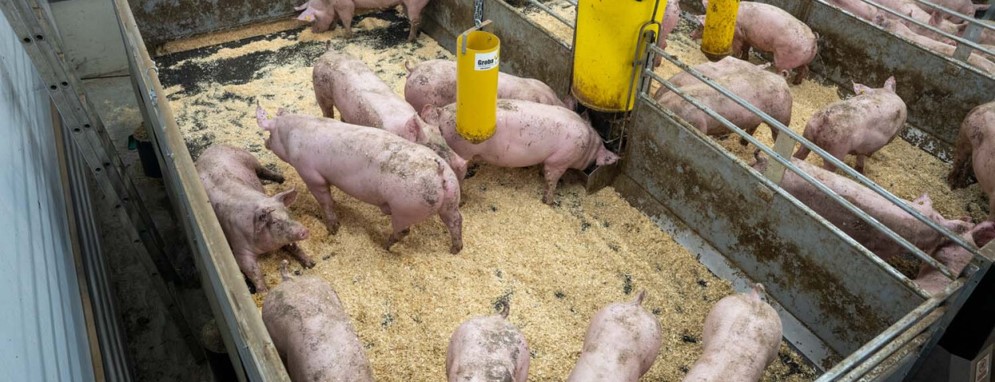
Poultry farmer Math Lemmers from Dutch Limburg decided to change course due to the limited future prospects of his existing farm location. He switched to a mixed farming model focused on short supply chains and local sales. Part of this circular farming model is the “Moving Floor” stable concept, in which pigs are housed on moving conveyor floors. The continuous removal of manure reduces ammonia emissions. A group of Flemish farmers visited the farm to see the system in practice.
Lemmers transformed his large-scale poultry farm in Weert, just across the Belgian border in the Netherlands, into an urban farm combining care services, education, and regional food sales. “We are located close to the village center, and the future outlook here was uncertain,” the farmer explains.
The transformation also included diversifying his poultry operation with beef cattle and pigs. In the future, he hopes to process the meat in his own cutting facility and sell it through one or more regional outlets. By managing the entire chain himself, the entrepreneur believes he can create more added value from livestock farming.
The business model also places strong emphasis on animal welfare and circular agriculture. The broilers, laying hens, and cattle are housed in “Beter Leven” certified barns. For the hundred pigs that recently arrived on the farm, Lemmers selected the Moving Floor system. This Swedish barn concept uses a conveyor belt floor that periodically shifts forward, quickly removing manure and urine from the stable.
The Hushoven urban farm serves as a demonstration site for the concept. The Swedish developers claim the rapid manure removal can reduce ammonia emissions by 85 percent. According to Lemmers, preliminary measurements currently indicate reductions ranging from 75 to 95 percent.
Flemish Farmers Take a Look
The concept is also attracting interest from Flanders. On Monday, the Dutch-Limburg pioneer welcomed a delegation of Flemish farmers. They visited the pilot farm as part of the “Tour de Boer,” an initiative within the Flemish-Dutch Interreg project RAMBO, short for “Reduction of AMmonia through Source-oriented and Supporting Solutions.” The project focuses on developing advanced measures and technologies that enable livestock farmers, especially poultry and pig farmers, to significantly reduce ammonia emissions.
One of the Flemish participants was pig farmer Davy Hens from Brecht. He faces the challenge of implementing emission-reducing measures in two-thirds of his barns by 2030. He sees potential in the system. “It’s a nice system, but everything depends on the cost,” he says. Costs vary depending on whether a farmer must build new barns or can adapt existing infrastructure.
Some livestock farmers from West Flanders were more skeptical. Besides the purchase price, they pointed to possible maintenance costs. The many mechanical components could make the system more maintenance-sensitive than conventional barns.
The cost of the barn units with moving floors in the pilot setup amounts to 4,000 euros per unit. Since Lemmers keeps ten pigs on 10.4 square meters, this translates to roughly 400 euros per pig place. The farmer notes that manure disposal costs, which are higher in the Netherlands than in Flanders, also influence the financial calculation. “The manure is removed together with the straw and can then be applied to fields as composted farmyard manure. In that way, a cost item becomes a revenue model,” he explains.
Fine-Tuning the Barn System
Lemmers is currently testing different bedding materials, including straw, sawdust, and peat. “We are investigating which option gives the best reduction results and which materials the pigs respond to best,” he says.
Adjusting the ventilation system also proved challenging. The airflow is now directed toward the end of the pens, where the conveyor belt feeds into an auger system that removes the manure. This setup is intended to encourage the pigs to relieve themselves there, keeping the rest of the stable cleaner.
The flooring itself is another point of attention. At present, the pigs walk on a smooth PVC surface and sometimes slip. Despite these startup issues, Lemmers says he is satisfied with the first months of operation. The reduced ammonia emissions have also improved the barn climate for both animals and workers.
Wageningen University to Conduct Measurements
Much of the system’s future potential will depend on official recognition of its ammonia-reduction performance. Lemmers’ farm is one of three test locations where researchers from Wageningen University & Research (WUR) will conduct measurements to validate the claimed reduction percentages. This validation is a necessary step toward official recognition of the system as a PAS (nitrogen reduction) measure.
“A Dutch approval could also be fast-tracked onto the PAS list in Flanders through a fast-lane procedure,” says Proef- en Vormingscentrum voor de Landbouw (PVL) representative Sander Palmans. Within a year, the Limburg-based research institution hopes to install a Moving Floor system in Bocholt as well, allowing the stable concept to gain a foothold in Flanders. PVL and Moving Floor are currently collaborating in a PAS project supported by Boerenbond, with the farmers’ organization providing financial resources for the initiative.
According to Lemmers, the barn concept also has considerable potential in Flanders, particularly as part of a circular farming model combined with short supply chains and direct farm sales. “In Flanders too, development opportunities for farmers, especially near urban areas, are limited, and a mixed farming business with on-farm sales could become a viable revenue model.”
Translated from an original article published by VILT on May 19, 2026.
Vlaamse boeren bezoeken bewegende stalvloer in Nederland: minder ammoniakuitstoot en lagere mestafzetkosten | VILT vzw